Buying insurance used to involve sitting through meetings, collecting brochures and comparing quotations manually.
Today, much of that process can be done online. You can research different types of insurance, estimate how much coverage you need, compare plans and, for some policies, complete the application without leaving home.
But convenience does not necessarily make the decision simpler.
If you are looking to buy insurance online in Singapore, the important question is not only whether a policy can be purchased digitally. It is whether you understand what you are buying and have compared the right things before making a decision.
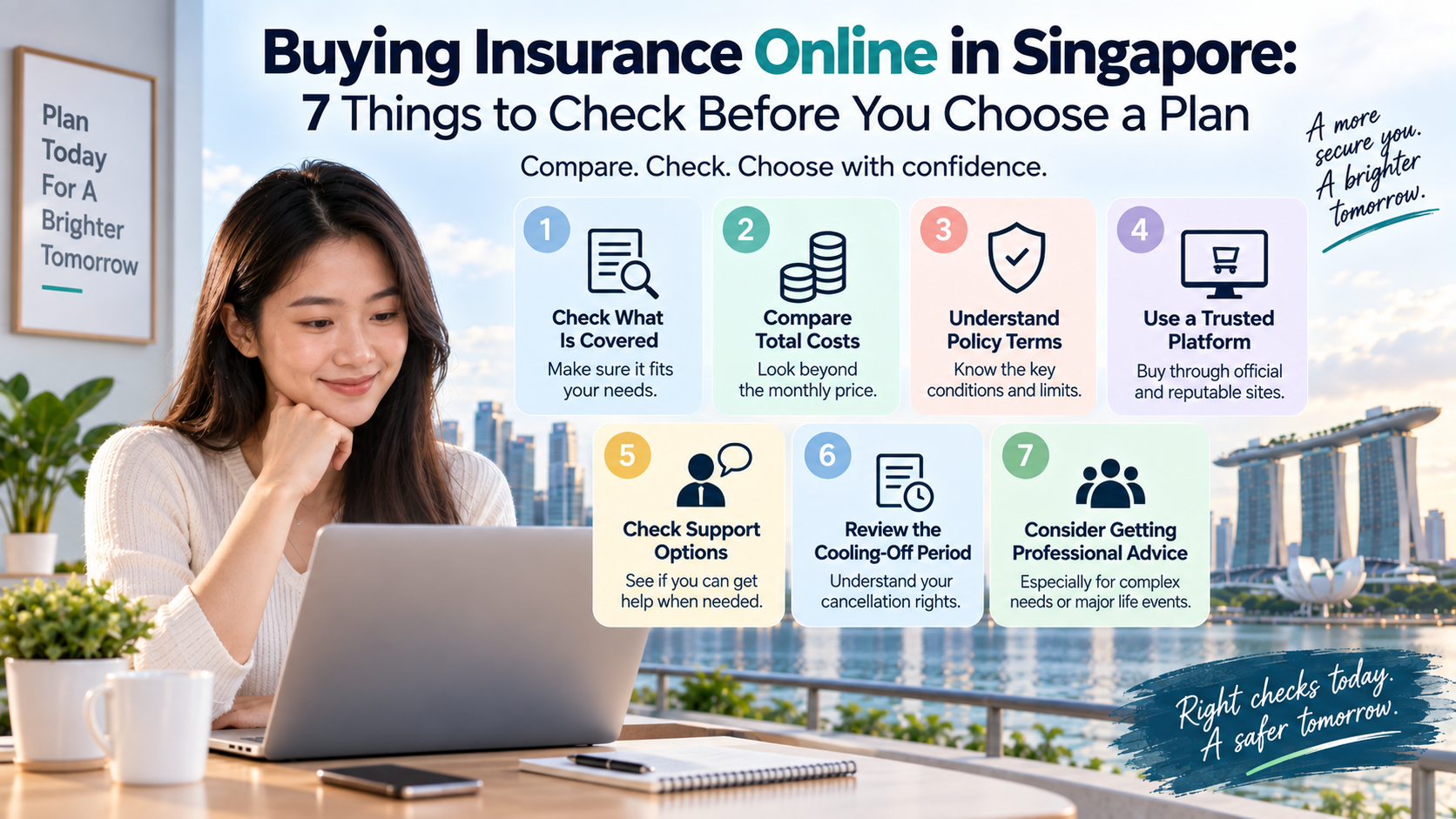
Here are seven things worth checking.
1. Start with what you actually need
It is tempting to begin by looking at products.
A better place to start is with the financial risk you are trying to protect against.
If you are comparing hospitalisation insurance, for example, think about the level of hospital care you would be comfortable with and how much of a medical bill you could afford to pay yourself.
For life insurance, the question may instead be how much your family would need if your income disappeared.
Travel insurance, motor insurance and home insurance solve completely different problems again.
Knowing what you need makes online comparison much more useful because you are comparing policies against a clear objective rather than simply browsing what is available.
2. Compare similar levels of coverage
A cheaper policy is not necessarily better value.
Two plans can have very different premiums because the benefits themselves are different.
When comparing online, check whether you are really comparing like for like.
Depending on the type of insurance, this may include:
- The amount of coverage
- Benefit limits and sub-limits
- Deductibles or co-payments
- Policy duration
- Exclusions
- Waiting periods
- Panel or network requirements
- Renewal terms
For example, one plan may appear significantly cheaper but provide a lower benefit limit. Another may cost more because it includes protection that you do not actually need.
The premium only makes sense when considered together with the coverage.
3. Don’t choose based on price alone
Price naturally matters, especially for policies you may be paying for over many years.
But the lowest quotation should be a starting point for further comparison rather than the automatic winner.
Insurance exists for the point when something has gone wrong.
At that stage, what matters is whether the event is covered, how much the insurer will pay and what conditions apply.
The same applies in the other direction. A more expensive policy is not automatically better simply because it contains more benefits.
The aim is to find coverage that is appropriate for you at a premium you are comfortable maintaining.
4. Read the exclusions
Benefits tend to receive the most attention when insurance is marketed.
Exclusions are just as important.
An exclusion describes circumstances where the insurer will not pay a claim. Different types of insurance will have different exclusions and conditions, so it is worth understanding these before you buy rather than discovering them when you need to make a claim.
You do not necessarily need to memorise every line of a policy document.
But you should understand the major limitations that could affect the reason you are buying the insurance in the first place.
If something is unclear, ask.
5. Check whether the insurer needs more information from you
Buying insurance online does not mean every application is automatically approved.
For certain types of insurance, an insurer may need additional information before deciding whether it can offer coverage and on what terms.
Health declarations are a common example.
If you have a past or existing medical condition, the insurer may ask further questions or request medical information. It may then offer standard coverage, impose an exclusion, adjust the terms or decline the application.
This is also why it is important to answer application questions accurately.
The convenience of an online application does not change your obligation to provide the information the insurer asks for.
6. Find out what happens after you buy
This is easy to overlook when everything is going smoothly.
Before purchasing a policy online, check what happens if you need help later.
Who do you contact if you have a question about your coverage?
What happens at renewal?
If you need to make a claim, will you deal directly with the insurer, an adviser or another service team?
There is no single correct model. Some people are comfortable handling everything directly with an insurer, while others value having someone familiar with their policies whom they can approach for help.
What matters is knowing which arrangement you are choosing.
At Planner Bee, we see this frequently. Customers may initially come to us because they want to compare insurance plans, but questions often arise later during servicing, renewals and claims.
That is why after-sales support should be part of the comparison, not an afterthought.
7. Compare more than one insurer
Going directly to an insurer’s website is useful if you already know which company you want to buy from.
But if you are still deciding, looking at more than one insurer gives you a broader view of the market.
Products that solve the same general problem can still differ substantially in price, benefits and terms.
Comparison does not mean finding the insurer with the longest list of benefits. It means understanding your options well enough to decide which trade-offs matter to you.
Consumers who want to research different options can use Planner Bee’s insurance comparison platform, which compares insurance across 29 insurers and more than 500 products in Singapore.
You can research and compare options online first, and speak to a licensed representative when you need help understanding the differences or completing an application.
Online does not have to mean doing everything alone
The ability to buy insurance online gives consumers more control over the process.
You can do your own research, compare products at your own pace and understand the options before speaking to anyone.
That is a good thing.
But buying online and getting advice are not opposites.
For a straightforward policy, you may be comfortable making the decision yourself. For something more complicated, you may want someone to explain the trade-offs or help you understand how a new plan fits with insurance you already own.
What matters is that the decision is informed.
Before clicking “buy”, make sure you know what the policy covers, what it does not cover, how much you will pay and who you can turn to if you need help later.
Convenience should make it easier to make a good insurance decision, not simply a faster one.